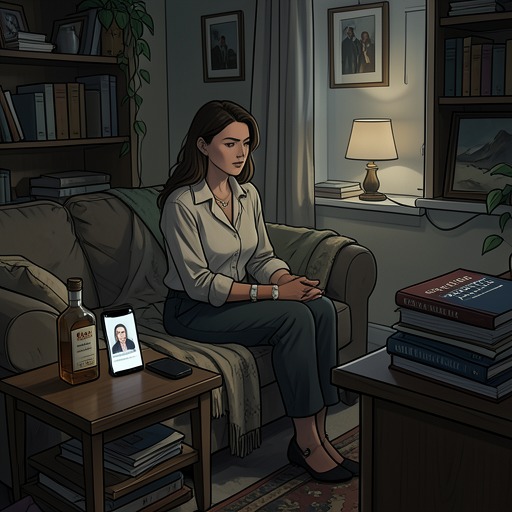
Perception, truth, and credibility
The Woman in the WindowPerception, truth, and credibility are central to the way the novel turns Anna Fox’s report into a contested account rather than an immediately accepted fact. Anna is certain she saw Jane Russell in danger, but the people questioning her repeatedly treat her circumstances as reasons to doubt what she says. The tension is not simply between truth and falsehood: it also concerns how a claim is recorded, what can corroborate it, and whose account is granted weight.
The report and its record
Anna’s call to emergency services begins with urgency and confusion. After recovering her phone and entering its passcode, she dials 911 and reports that her neighbor has been stabbed, asking for help. The call establishes that she made a report, but its audible qualities later become part of the case against her: the police draw attention to how difficult she was to understand, rather than treating the call only as a record of her attempt to summon assistance.
Val Norelli plays the recording to Anna during the confrontation at her home. She notes that the dispatcher remained on the line for six minutes, until emergency medical technicians confirmed that they had arrived. That detail gives the call a concrete timeline and shows that the report prompted a sustained response. It does not, by itself, establish what responders found or prove the event Anna described. The distinction between evidence that a call occurred and evidence that its contents were accurate becomes crucial.
Competing explanations
Detective Little offers a possible explanation based on Anna’s alcohol use, medication, and the film she was watching. He suggests that these combined circumstances may have overstimulated her and led her to see something that was not there. Anna rejects the suggestion that she hallucinated, insisting that she saw what she saw. When the detectives raise the possibility that her medication can cause hallucinations, the dispute shifts from the reported event to the reliability of the person reporting it.
The questioning also draws on information about Anna’s life. Val Norelli says that Alistair Russell has reported that his wife has been away and that Anna had never met her. She points to Anna’s separation from her family and her limited presence in the neighborhood, then proposes that loneliness and drinking could explain why Anna made a disturbance report. Detective Little frames the possibility more gently, suggesting that Anna may have been going stir-crazy at home. Their accounts are not identical, but both use her circumstances to supply an alternative explanation for what she says she witnessed.
Anna’s response exposes the personal cost of that shift. She insists that she saw a woman covered in blood through the window and accuses the investigators of imagining things themselves. Her certainty does not settle the factual question; equally, the police’s speculation does not refute her observation. The scene keeps those positions in conflict, while showing how quickly a witness’s isolation and distress can become grounds for questioning not only a particular perception but her general credibility.
Credibility, isolation, and suspicion
The police confrontation makes credibility depend on more than the content of Anna’s report. Her separated status, the distance from her family, her tendency to remain indoors, and her drinking are assembled into a profile that can make her seem unreliable before the reported event is independently established. Val Norelli explicitly suggests that Anna may have wanted attention. The theory converts social isolation into a possible motive and makes the absence of nearby witnesses appear to count against her.
This reasoning is consequential because Anna’s claim concerns a neighbor whom Alistair says she has never met. If the police accept his account that his wife was out of town, Anna’s sighting is not merely mistaken in their view; its basic premise is called into question. Anna’s insistence that she saw Jane Russell therefore has to contend with an account offered by the household she is accusing, while her own personal circumstances are used to discount her testimony. The conflict is about competing sources as much as competing descriptions.
Records and corroboration
A later exchange about a Gmail account extends the problem from human testimony to traceable evidence. Anna asks whether the account can be tracked. Val Norelli explains that it cannot be traced in the way Anna hopes and raises the possibility that Anna sent the material to herself. This does not establish that she did so; it introduces a possible alternative that leaves the material’s source unverified. The episode again separates the existence of an item from what can reliably be inferred about its origin.
David’s later account offers another view of how the lack of corroboration shaped the police response. He tells Anna that officers came the day after a reported disturbance, that his parents denied it, and that they understood the situation to be Anna’s word against theirs. He says no one else had seen the woman. Anna counters that David had seen her and spent four nights with her. The exchange places a potential witness alongside the earlier claim of having no corroboration, but the evidence here presents the disagreement rather than a formal resolution of it. What counts as independent support remains unsettled.
Denial and the limits of judgment
The confrontation also reveals why Anna’s account cannot be assessed apart from what she has lost. Val Norelli tells her that her husband and daughter are dead. Anna acknowledges that they are dead, and Dr. Julian Fielding identifies her prior refusal to accept that reality as denial. This disclosure clarifies that her perception and judgment exist within severe grief; it does not, on its own, prove that her report about Jane Russell was false. The novel keeps those questions distinct even as the characters’ tendency to merge them makes Anna’s credibility more vulnerable.
Across the call, the playback, the speculation about medication and alcohol, and the competing accounts of possible witnesses, the novel presents credibility as something produced through evidence and social judgment rather than as a simple quality a speaker possesses. Anna’s distress can be relevant to evaluating her perception, but it becomes a substitute for checking what happened when investigators treat it as an answer. The resulting uncertainty is structural: readers must weigh the recorded report, the claims made about Anna, and the gaps in corroboration without confusing suspicion with proof.